Before Investing in New Software, Assess Your Information System
Before investing in a new software tool, take time to assess your information system, business processes, data quality and actual operational needs.
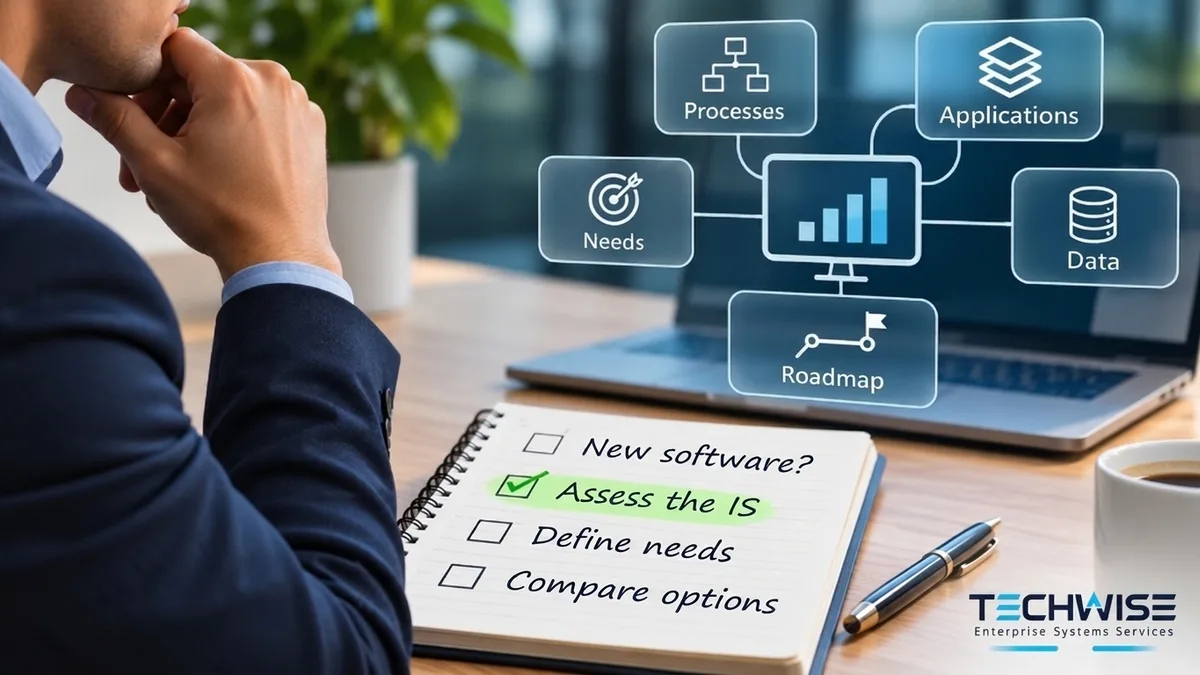
When an organisation faces friction in its day-to-day operations, one of the first instincts is often to look for a new piece of software.
A sales management tool, an ERP, a CRM or a specialised business application can look like the obvious fix. Yet replacing or adding software does not automatically resolve organisational bottlenecks, broken information flows or poor coordination between departments.
In many cases, the root issue is not the software itself, but how it fits into the surrounding working environment.
Before committing budget and team time, stepping back to assess the information system as a whole is far more productive. The goal is not merely to decide which tools to replace, but to understand how the organisation operates, how information moves and which changes will genuinely create value.
1. Start by Understanding the Business Problems
The first step is to clarify the operational problems the organisation is actually trying to solve. Useful starting questions include:
- Which tasks take too long?
- Which pieces of information are entered multiple times?
- Which workflows still rely on manual file exchanges or emails?
- Do teams have the information they need to make timely decisions?
- Where does cross-department coordination break down?
- Which processes depend heavily on a single individual?
It is essential to separate the business problem from the assumed technological solution. For example, an organisation may ask for a new CRM because it lacks visibility into its sales pipeline. However, the real cause may be the absence of a clear commercial process, unclear ownership or inconsistent habits in updating records.
Deploying a CRM without addressing those underlying issues often reproduces the exact same friction inside a new tool.
2. Map Existing Applications and Tools
Few organisations rely on a single piece of software for everything. Most operate a mix of an ERP, management tools, spreadsheets, accounting software, communication apps and custom-built utilities.
Mapping these existing tools and their real role in daily operations is a vital baseline. For each application, review:
- Its purpose in the organisation and the teams and users who rely on it
- The data it holds and its core features
- Its functional or technical limitations
- Its dependencies on other systems
- How data is exchanged with surrounding tools
Looking at the landscape as a whole often surfaces issues that remain invisible when reviewing one tool in isolation: overlapping applications performing the same job, reference data duplicated across spreadsheets or handoffs that depend entirely on manual intervention.
3. Examine Data Circulation and Quality
Data sits at the heart of any information system. Even with capable applications in place, an organisation will struggle if its underlying data is incomplete, duplicated or inconsistent.
Take time to review how data is created, updated, shared and used:
- Is customer information consistent across tools?
- Are multiple versions of the same reference file circulating?
- Does data have to be re-keyed from one system to another?
- Can managers rely on their reporting indicators?
- Are exchanges between applications automated or manual?
- Is ownership for keeping data up to date clearly assigned?
A common pitfall is accumulating standalone tools without proper integration. In that situation, buying yet another software product simply adds one more data silo without fixing consistency or information flow.
4. Define Requirements Before Selecting a Solution
Once workflows, applications and data flows are clear, the organisation is in a much stronger position to formalise its requirements across three dimensions:
- Functional requirements: what operations must the solution support? What are the user journeys, business rules and expected outputs?
- Technical requirements: what are the hosting, integration, security, availability, maintenance and scalability constraints?
- Organisational requirements: which departments are affected? Who will use the system? Which responsibilities will shift, and what training or change support will be needed?
Structuring requirements this way prevents software selection based purely on a polished sales demo or a long feature checklist. Any candidate solution should be evaluated against actual operational needs, constraints and the organisation's capacity to run it sustainably.
5. Compare Practical Options Before Deciding
An information systems assessment can lead to several valid paths — replacing a tool is only one option among others:
- Optimise what you already have: some bottlenecks can be resolved through better configuration, more disciplined usage or clearer processes.
- Integrate existing applications: when current tools already do their individual jobs well, targeted integration can streamline data flow and eliminate duplicate entry.
- Replace an application: when a legacy tool no longer meets operational needs or imposes severe limitations, replacement may be the right call.
- Build a targeted custom solution: when specific business workflows are not adequately covered by standard products, custom development can be considered after weighing configuration and integration alternatives.
These paths are not mutually exclusive; many organisations combine them. The right decision balances expected benefits, costs, risks, technical dependencies and the organisation's readiness to absorb change.
6. Turn the Assessment into an Actionable Roadmap
An assessment only creates value when it prepares concrete decisions. By the end of the exercise, the organisation should have a clear picture of:
- Its current application landscape and key pain points
- Processes to improve and priority functional and technical requirements
- Options for optimisation, integration or replacement
- Constraints and risks to consider
- Immediate next steps
Depending on the engagement scope, these findings can be structured into an application map, a requirements brief and a practical evolution roadmap.
Launching a massive transformation programme right away is not always necessary. Targeted, well-scoped improvements often make a far stronger first step before committing to larger investments.
Does Your Information System Need an Assessment?
Before committing to a software investment, ask yourself these six quick questions:
- Do your teams regularly re-enter the same information across multiple tools or Excel spreadsheets?
- Do different departments maintain conflicting versions of the same data (customers, inventory, orders, KPIs)?
- Do key operational workflows still depend on manual file exchanges or emails?
- Do managers struggle to get reliable, up-to-date indicators for decision-making?
- Do critical processes rely heavily on a single individual?
- Are you considering buying or replacing software (ERP, CRM, business application) without having mapped your current tools or formalised your requirements?
If you answered yes to several of these questions, a structured information system assessment can help you clarify your priorities before committing to a software investment.
Conclusion: Understand First, Invest Second
New software can bring meaningful operational improvements — but its real value depends on how well it addresses an actual business need and how cleanly it integrates into the existing environment.
Before choosing an ERP, CRM or custom application, taking time to assess your processes, applications, data and constraints reduces rushed decisions and directs technology spending where it matters most.
At Tech Wise Advisors, this is how we work: understanding your business context and existing information system before recommending any technological change. Tech Wise Advisors — The bridge between your business goals and technology.
Considering improving your information system? Let's discuss your business context, operational challenges and objectives.
Contact Tech Wise Advisors